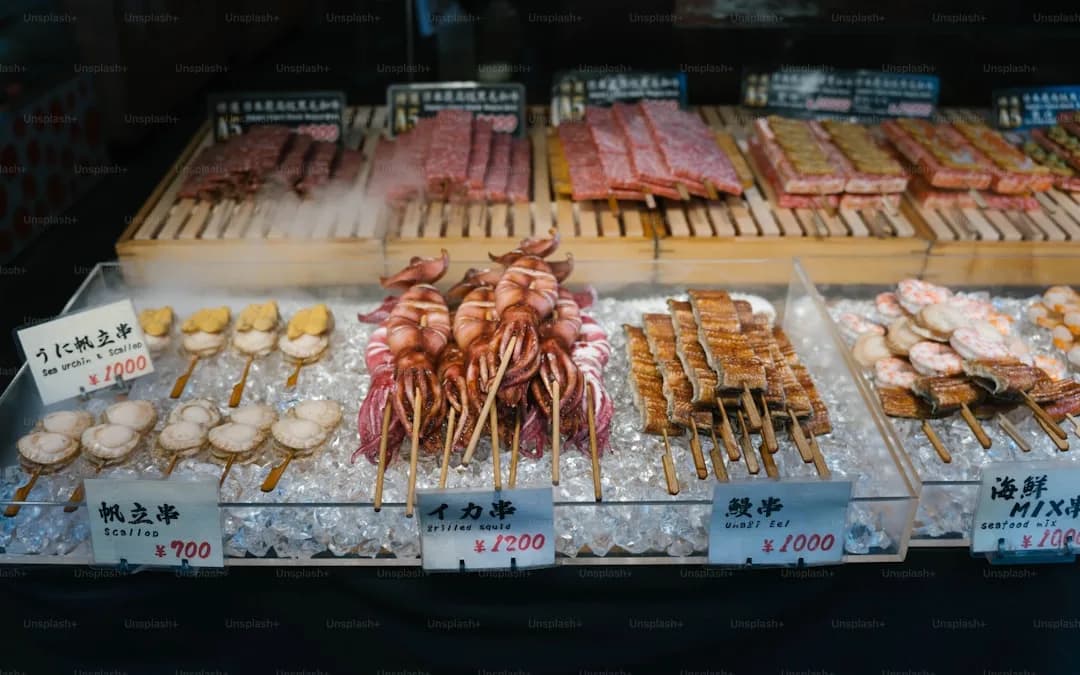
Japanese Food Guide: 20 Dishes Every Traveler Must Try
Japanese cuisine was inscribed as a UNESCO Intangible Cultural Heritage in 2013, and after eating your way through the country, you will understand why. Japan takes food seriously at every level -- from the Michelin-starred restaurants of Tokyo (which has more Michelin stars than any other city on earth) to the Y130 onigiri at 7-Eleven that is somehow perfect every single time. The attention to ingredients, technique, and presentation runs through the entire food culture, from street stalls to kaiseki dining rooms.
This guide covers 20 essential Japanese dishes, along with what they cost, where to find the best versions, and how to navigate the ordering process.
The Essential 20
1. Sushi (Y1,000-30,000+)
Sushi is Japan's most famous export, and eating it in its homeland is a different experience entirely. The fish is fresher, the rice is seasoned with more care, and the variety is broader than anything you have encountered abroad.
Where to eat it:
- Kaiten-zushi (conveyor belt): Y100-200/plate. Sushiro, Kura Sushi, and Hamazushi are excellent chains. Don't let the low prices fool you -- the quality is remarkable.
- Standing sushi bars: Y1,500-3,000 for a satisfying meal. Common near fish markets and train stations.
- Mid-range sushi restaurants: Y3,000-8,000. Midori Sushi in Shibuya and Ginza is outstanding value.
- Omakase (chef's choice): Y10,000-30,000+. The ultimate experience. Reservations essential at top spots -- book 1-3 months ahead.
How to order: At conveyor belt spots, grab plates off the belt or order via the touchscreen tablet (usually available in English). At sit-down restaurants, omakase lets the chef choose for you. "Okonomi" means you order individual pieces.
2. Ramen (Y800-1,500)
Ramen might be Japan's most universally loved comfort food -- a bowl of wheat noodles in rich broth with various toppings. Japan has hundreds of regional ramen styles, but the main categories are:
- Tonkotsu: Creamy pork bone broth, originally from Fukuoka/Hakata. Rich and milky.
- Shoyu (soy sauce): Clear-ish brown broth, the Tokyo standard. Lighter than tonkotsu.
- Miso: Hearty, savory broth, originated in Sapporo. Warming in winter.
- Shio (salt): The lightest style, with a clear, clean broth. Often underrated.
- Tsukemen: Dipping ramen -- noodles served cold alongside a concentrated broth for dipping.
How to order: Most ramen shops use a ticket vending machine (shokkenki) at the entrance. Insert money, press the button for your bowl, and hand the ticket to the staff. Customize with garlic, chili oil, and extra toppings. The machine sometimes has English, sometimes not -- when in doubt, the top-left button is usually the house special.
Top picks:
- Fuunji (Shinjuku) -- Tsukemen. Y900.
- Ichiran (multiple locations) -- Tonkotsu in private booths. Y980.
- Afuri (multiple locations) -- Light yuzu shio ramen. Y1,050.
- Rokurinsha (Tokyo Station) -- Rich tsukemen with long lines. Y900.
3. Tempura (Y1,000-5,000)
Lightly battered and deep-fried seafood and vegetables. Good tempura has an impossibly thin, crispy coating that barely conceals the ingredient inside. Common items include shrimp (ebi), sweet potato, lotus root, eggplant, shiso leaf, and squid.
Where to eat it:
- Tenya chain -- Budget tempura bowls (tendon) from Y550. Surprisingly good.
- Mid-range tempura restaurants -- Sit at the counter and watch the chef fry each piece to order. Y2,000-4,000.
- High-end tempura -- Omakase-style counter dining. Y8,000-15,000.
4. Tonkatsu (Y1,000-2,000)
A thick slab of pork loin (rosu) or tenderloin (hire), breaded in panko breadcrumbs and deep-fried until golden. Served with shredded cabbage, rice, miso soup, and a tangy brown sauce. The cabbage is unlimited at most tonkatsu restaurants.
Top picks:
- Maisen (Omotesando, Tokyo) -- Arguably Tokyo's most famous tonkatsu. Y1,600-2,200.
- Butagumi (Nishi-Azabu, Tokyo) -- Uses high-grade kurobuta (black pork). Y2,500-4,000.
- KYK (Osaka) -- Reliable chain across Kansai. Y1,200-1,800.
5. Okonomiyaki (Y800-1,500)
A savory Japanese pancake loaded with shredded cabbage and your choice of meat or seafood, cooked on a flat griddle and topped with okonomiyaki sauce, Japanese mayonnaise, bonito flakes, and seaweed.
Two main styles:
- Osaka style: Everything mixed into the batter before cooking. Often cooked at your table.
- Hiroshima style: Layered with noodles, a fried egg, and loads of cabbage. More substantial.
Where to eat it:
- Dotonbori district in Osaka for Osaka-style. Mizuno and Fukutaro are classics.
- Okonomimura in Hiroshima -- a multi-floor building with dozens of Hiroshima-style stalls.
6. Yakitori (Y100-300/skewer)
Grilled chicken skewers cooked over charcoal, seasoned with either tare (sweet soy glaze) or shio (salt). Yakitori joints range from smoky under-the-tracks stalls to refined restaurants. Common skewer types include momo (thigh), negima (thigh with leek), tsukune (chicken meatball), kawa (skin), and hatsu (heart).
Where to eat it:
- Yakitori Alley (Yurakucho, Tokyo) -- Under the train tracks, atmospheric and cheap. Y80-200/skewer.
- Torikizoku chain -- Y350 for 2 skewers + a drink. Japan's best value yakitori.
- Omoide Yokocho (Shinjuku, Tokyo) -- "Memory Lane," a narrow alley of tiny yakitori bars.
7. Udon (Y400-1,200)
Thick, chewy wheat noodles served in a mild dashi broth or chilled with a dipping sauce. Sanuki udon from Kagawa Prefecture (Shikoku) is the most famous style -- bouncy noodles with a satisfying bite.
Types:
- Kake udon -- Simple hot broth. Y300-500.
- Kitsune udon -- Topped with sweet fried tofu. Y500-800.
- Tempura udon -- With a piece of tempura on top. Y600-900.
- Zaru udon -- Cold noodles with dipping sauce. Y500-800.
Top pick: Marugame Seimen is a nationwide chain where udon is made fresh in front of you. From Y390.
8. Soba (Y500-1,500)
Thin buckwheat noodles served cold with a dipping sauce (zaru soba) or hot in a broth (kake soba). High-quality handmade soba (teuchi soba) is an art form, with specialist restaurants grinding their own buckwheat.
Where to eat it:
- Standing soba shops at train stations -- Y400-600 for a quick, hot bowl. A commuter tradition.
- Teuchi soba restaurants in Kyoto, Nagano, and Tokyo -- Y1,000-1,500. Watch the noodle-making process.
9. Curry Rice / Kare Raisu (Y500-1,000)
Japanese curry is milder, sweeter, and thicker than its Indian or Thai counterparts. It is a national comfort food, served over rice with a choice of topping -- typically breaded pork cutlet (katsu curry), chicken, or vegetables.
Where to eat it:
- CoCo Ichibanya -- Japan's largest curry chain. Customize spice level (1-10), rice amount, and toppings. From Y550.
- Go! Go! Curry (Tokyo, Kanazawa) -- Thicker, darker Kanazawa-style curry. From Y750.
10. Gyudon (Y400-700)
Thinly sliced beef simmered in sweet soy sauce over rice. Japan's ultimate fast food -- filling, tasty, and served in minutes.
- Yoshinoya -- The original. From Y448.
- Matsuya -- Slightly cheaper, includes miso soup. From Y400.
- Sukiya -- Widest variety of toppings. From Y400.
11. Takoyaki (Y500-800)
Ball-shaped snacks filled with diced octopus, cooked in a special molded pan and topped with sauce, mayo, bonito flakes, and green laver. A street food icon of Osaka but found nationwide.
Where to eat it:
- Dotonbori, Osaka -- Multiple famous stalls. Wanaka and Kukuru are standouts.
- Festival (matsuri) food stalls anywhere in Japan.
12. Gyoza (Y300-600)
Pan-fried dumplings with a crispy bottom and juicy pork and vegetable filling. Usually served as a side dish with ramen or as a standalone snack with beer. Dip in soy sauce mixed with rice vinegar and chili oil.
Top pick: Gyoza no Ohsho -- Nationwide chain. A plate of 6 gyoza costs Y290-350.
13. Unagi / Eel (Y2,000-5,000)
Freshwater eel glazed with a sweet soy-based tare sauce and grilled over charcoal. Served over rice (unadon or unaju). Considered a stamina food, traditionally eaten on the hottest day of summer (Doyo no Ushi no Hi).
Where to eat it:
- Obana (Tokyo, near Narita) -- Famous old-school unagi restaurant. From Y3,000.
- Hitsumabushi style in Nagoya -- Eel served three ways (plain, with condiments, as tea-broth soup). From Y3,500.
14. Kaiseki Ryori (Y10,000-30,000+)
The pinnacle of Japanese cuisine -- a multi-course meal that is as much art as food. Each course emphasizes seasonal ingredients, precise cooking techniques, and beautiful presentation. A typical kaiseki dinner has 7-14 small courses.
Where to eat it:
- Kyoto is the kaiseki capital. Look for restaurants with a Tabelog score above 3.5.
- Many ryokan (traditional inns) include kaiseki dinner. A night at a quality ryokan with kaiseki starts around Y15,000/person.
15. Wagyu Beef (Y3,000-20,000+)
Japan's marbled beef is graded on a scale from A1 to A5, with A5 being the highest. Kobe beef is the most famous brand, but Matsusaka, Omi, and Miyazaki beef are equally exceptional. Common preparations include yakiniku (grilled at the table), sukiyaki (hotpot), shabu-shabu (quick-boiled), and teppanyaki (griddle).
Budget option: Yakiniku (Japanese BBQ) restaurants offer lower-grade wagyu cuts from Y1,500-3,000. Look for tabehoudai (all-you-can-eat) deals from Y3,000-5,000.
16. Onigiri (Y120-250)
Rice balls wrapped in nori (seaweed) with various fillings -- salmon (sake), tuna mayo, pickled plum (umeboshi), kelp (konbu). Available at every convenience store in Japan. The packaging keeps the nori crispy until you unwrap it using a clever three-step pull system.
Pro tip: Konbini onigiri are the ultimate Japan snack. Try different fillings each day. The seasonal and regional limited editions are always worth sampling.
17. Matcha Desserts (Y300-800)
Green tea (matcha) is used in a dazzling array of desserts: ice cream, parfaits, mochi, cakes, tiramisu, and Kit Kats. Kyoto and Uji are matcha heartlands, but matcha desserts are everywhere.
Where to eat it:
- Nakamura Tokichi (Uji) -- Historic tea house with matcha parfaits. From Y1,200.
- Tsujiri (Kyoto, nationwide) -- Matcha soft serve from Y350.
- Any convenience store -- Matcha flavored sweets fill dedicated shelf sections.
18. Mochi (Y100-500)
Pounded sticky rice formed into chewy cakes, often filled with sweet red bean paste (anko). Varieties include daifuku (round mochi with filling), warabi mochi (jelly-like with kinako powder), and yatsuhashi (Kyoto's famous triangular mochi).
19. Taiyaki (Y200-350)
Fish-shaped pastry filled with red bean paste, custard, chocolate, or even cheese. Cooked in a fish-shaped mold and served hot. A classic street snack found at festivals and dedicated taiyaki shops.
20. Convenience Store Food
This deserves its own category. Japanese konbini food is in a class of its own:
- Egg sandwiches (tamago sando) -- Y200-300. Incredibly fluffy and creamy.
- Fried chicken (karaage) -- Y200-300. Lawson's "Karaage-Kun" is iconic.
- Bento boxes -- Y400-700. Full meals with rice, protein, and sides.
- Oden -- Y100-200/item. Hot pot ingredients (fish cakes, boiled eggs, daikon) in dashi broth, available in winter months.
- Premium desserts -- Lawson and 7-Eleven rotate seasonal pastries and cakes from Y200-400.
How to Order at a Japanese Restaurant
Ticket Vending Machines (Ramen, Gyudon, Some Soba)
Many budget restaurants use ticket vending machines at the entrance. The process is simple:
- Study the menu (photos or plastic food models are usually displayed)
- Insert cash (some accept IC cards)
- Press the button for your order
- Take the ticket to your seat and hand it to the staff or place it on the counter
Izakaya (Japanese Pubs)
Izakaya are informal pubs that serve small dishes alongside beer, sake, and other drinks. They are social eating at its best. A typical izakaya visit:
- You will receive a small appetizer (otoshi) automatically -- this is a cover charge (Y300-500), not optional.
- Order drinks first, then food. Sharing is the norm.
- Use the call button or say "sumimasen" to get the server's attention.
- Say "okaikei onegaishimasu" for the bill.
Budget for Y2,000-4,000/person including 2-3 drinks and several shared dishes.
Tablet and QR Code Ordering
Increasingly common, especially at chains. A tablet at your table or a QR code linked to your phone provides an English menu and ordering system. This is the easiest option for non-Japanese speakers.
Eating Etiquette
- Slurp your noodles. Seriously. It cools them down and is considered a sign of enjoyment.
- Do not tip. Tipping is not practiced in Japan and can cause confusion or embarrassment.
- Say "itadakimasu" (I humbly receive) before eating and "gochisosama deshita" (thank you for the meal) when finished.
- Chopstick rules: Never stick chopsticks upright in rice (funeral association). Never pass food chopstick-to-chopstick (same). Never point with chopsticks.
- Do not pour your own drink at social meals. Pour for others and they will pour for yours.
- Wet towels (oshibori) provided at restaurants are for your hands only, not your face.
Dietary Restrictions
Japan can be challenging for vegetarians and vegans, as dashi (fish stock) is used extensively, even in dishes that appear vegetarian. However, the situation has improved significantly:
- Vegetarian: Look for shojin ryori (Buddhist vegetarian cuisine), available at temples and specialized restaurants. Tell staff "niku to sakana nashi de" (without meat and fish).
- Vegan: Use the HappyCow app to find vegan-friendly restaurants. Tokyo and Kyoto have the most options.
- Gluten-free: Difficult, as soy sauce (which contains wheat) is ubiquitous. Rice-based dishes are generally safe. Tamari (wheat-free soy sauce) can sometimes be requested.
- Halal: Growing availability, especially in Tokyo. The Halal Gourmet Japan app maps halal-certified restaurants.
Key Takeaways
- Convenience stores are legitimate food destinations in Japan. Do not overlook them.
- Lunch sets at restaurants are 30-50% cheaper than dinner for the same quality.
- Regional specialties are a highlight -- ramen in Sapporo, okonomiyaki in Osaka, Hitsumabushi in Nagoya, Sanuki udon in Kagawa.
- Ticket machines at budget restaurants are easy once you understand the system.
- Tipping is never expected. Service charges are sometimes included at upscale restaurants.
- Try everything. The Y400 gyudon and the Y20,000 omakase sushi are both expressions of the same food culture that makes Japan extraordinary.
Frequently Asked Questions
How much should I budget for food per day in Japan?
Budget travelers can eat well for Y2,000-3,500/day ($13-23) by relying on convenience stores, chain restaurants, and ramen shops. Mid-range food lovers spending Y5,000-8,000/day ($33-53) can enjoy a mix of local restaurants, sushi, and izakaya. For a daily splurge that includes one high-end meal, budget Y10,000-15,000 ($67-100).
Do Japanese restaurants have English menus?
Tourist areas and chain restaurants increasingly offer English menus or picture menus. Izakaya and local restaurants in non-tourist areas may not. Google Translate's camera function works well on Japanese menus. The Tabelog and Gurunavi apps also help. Plastic food models displayed outside many restaurants are the universal visual menu.
Is Japanese food allergen-friendly?
Japanese law requires labeling of 8 major allergens (wheat, buckwheat, egg, milk, peanut, shrimp, crab, walnuts) on packaged foods. Restaurants are less consistent about allergen disclosure. If you have serious allergies, carry a translated allergen card (available to print from allergy translation websites). Communicate clearly and do not assume staff understand the severity.
What time do restaurants serve lunch and dinner?
Lunch is typically 11:00 AM to 2:00 PM. Many restaurants close between 2:00 and 5:00 PM. Dinner service starts at 5:00 or 6:00 PM and runs until 9:00-11:00 PM. Some izakaya stay open until midnight or later. Convenience stores and chain restaurants like Yoshinoya operate 24 hours.
Can I bring food on trains?
On local trains and subways, eating is considered rude. On long-distance trains (Shinkansen, limited express), eating is perfectly acceptable and even encouraged. Ekiben (train station bento boxes) are a beloved travel tradition. Buy one at the station before boarding -- the selection at major stations like Tokyo, Kyoto, and Shin-Osaka is extraordinary.
Sources & References
This article is based on first-hand experience and verified with the following official sources:
Go2Japan Team
Exploring Japan since 2021 | 35+ prefectures visited | Updated monthly
We are a team of travel writers and Japan enthusiasts who explore the country year-round. Our guides are based on first-hand experience, local knowledge, and verified official sources.
More about us →People Also Read
Best Time to Visit Japan: Season-by-Season Guide
Find the best time to visit Japan with our season-by-season guide. Cherry blossoms, autumn foliage, summer festivals, and winter snow -- month-by-month breakdown.
Japan Rail Pass 2026: Complete Guide to JR Pass
Complete 2026 guide to the Japan Rail Pass. Current prices, how to buy and activate, which trains are covered, and tips to maximize your JR Pass value.
Japan Travel Guide 2026: Everything You Need to Know
Complete Japan travel guide for 2026. Covers visas, budget, transport, culture, and practical tips for first-time visitors planning a trip to Japan.

Japan Visa Guide 2026: Requirements, eVisa & Entry Rules
Complete Japan visa guide for 2026. Visa-free countries, eVisa process, required documents, Visit Japan Web registration, and entry rules for tourists.
Plan Your Japan Trip
Book hotels, transport, activities, and get connected with an eSIM
Some links are affiliate links. We may earn a commission at no extra cost to you.